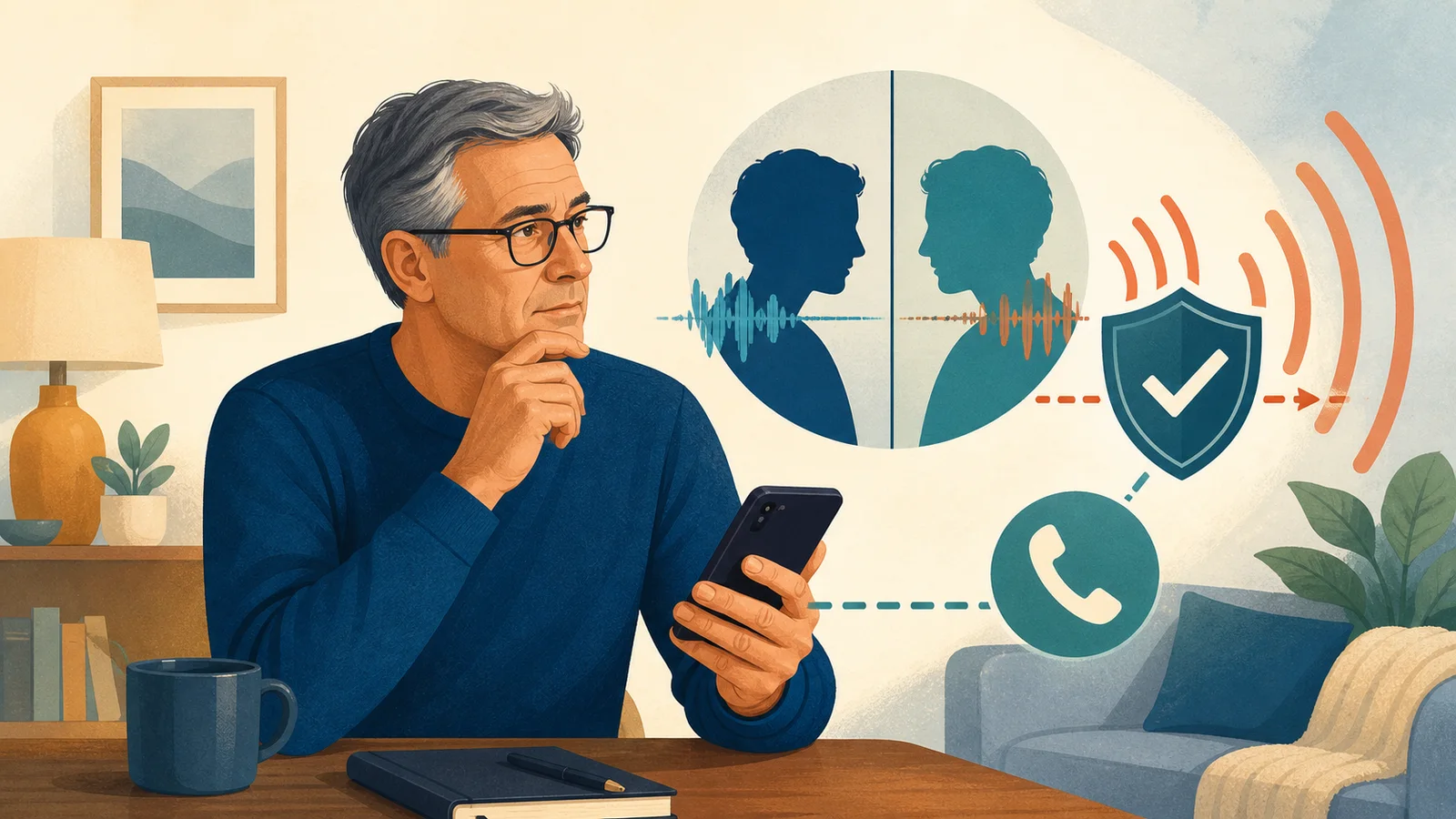
Say the phone rings at 9 p.m. It's your grandson — same voice, same way of saying "Grandma" — and he's crying. A car accident, he's at the police station, he needs bail money tonight, and please don't tell his parents. Your heart's pounding. Here's how to verify an AI voice family emergency call, because that voice can be faked now, and a scammer needs only a few seconds of audio from a video posted online to do it.
The one move that beats every version of this
Hang up and call him yourself — from the number already saved in your phone. Not a number the caller gives you, and not by tapping the call back in Recents (that may just dial the scammer again).
If he doesn't pick up, call his mom, his roommate, whoever would know where he is. Until someone you reached confirms the story, no money and no account numbers. A familiar voice isn't proof anymore.
What to say while they're still on the line
Don't feed them details. If you say "Is this Daniel?" you've just handed them the name. Ask "Who's calling?" instead, and don't mention where he lives, works, or is traveling.
Then say, "I need to check on this. I'll call you back," and hang up. You don't need their permission. If the emergency is real, a five-minute pause won't hurt anyone.
Why "call back" has to be your own route
The Federal Trade Commission's advice is the same as ours: don't trust the voice, call the person at a number you know is theirs. Caller ID can be faked, and the "lawyer" or "officer" they offer to transfer you to is still part of their setup.
Same separation habit as when you verify an unexpected invoice without clicking its links: the call makes a claim, but only a route you control provides the proof. If a jail or hospital really needs calling, look up its number on the official website yourself — not from a search ad, a text, or the caller.
The payment demand gives it away
Stop cold if they tell you to:
- buy gift cards and read the numbers aloud;
- wire money or send cryptocurrency;
- pay a stranger through a payment app;
- hand cash to a courier; or
- keep it secret from the family.
The FTC says fake-emergency scammers lean on exactly these, because the money can't be pulled back. Knowing your grandson's nickname or his trip last summer doesn't make any of that safe — that stuff is online.
Set up a family password now
Pick a short phrase that isn't a birthday, pet name, or anything on Facebook. Share it in person. The family rule: no phrase and no call-back means no money. Make the caller say it — don't offer it first.
It's not your only defense (someone might forget it), so pair it with the hang-up-and-call-back habit. And do a two-minute practice run once; you might discover a grandchild is saved under an old number. Our family emergency contact plan helps you write down the trusted numbers.
If you already sent money
Don't keep talking to the caller. Contact your bank, the gift card company, wire service, or payment app through its official number or app and say the payment was fraud — fast action sometimes works. Change any password you shared, and report it at ReportFraud.ftc.gov. Keep the caller's number and any texts as evidence.
Phone filters help with junk calls, but they can't tell a real voice from a clone — our 10-minute scam-call setup explains what they can and can't do.
You don't have to listen for glitches in the voice. Just hang up, call back your own way, and let the real story come to you.
Sources:
- Federal Trade Commission, Scammers use AI to enhance their family emergency schemes
- Federal Trade Commission, Scammers use fake emergencies to steal your money