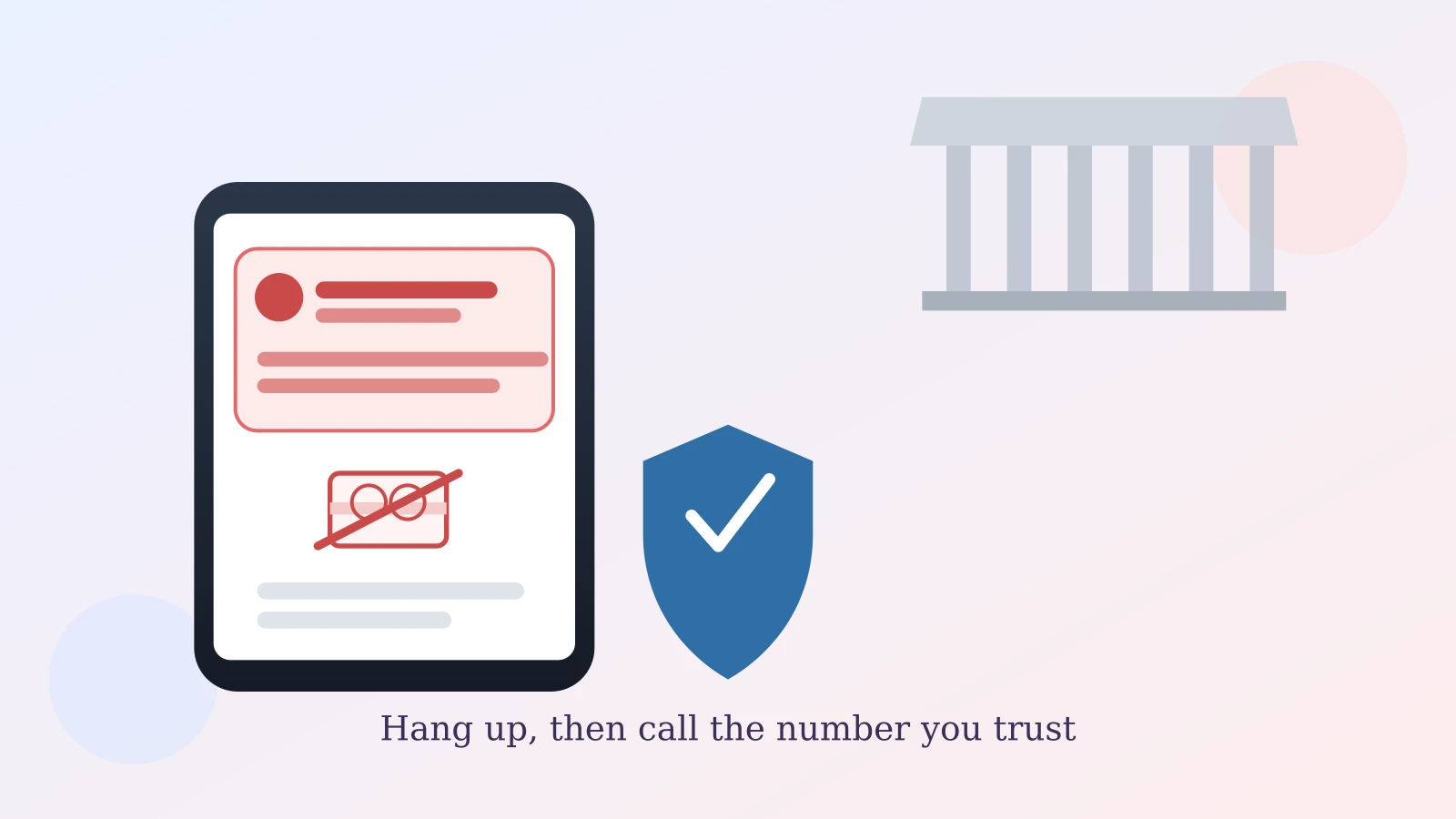
Say your phone rings and the caller ID says "Social Security Administration." A stern voice says your Social Security number has been "suspended" over suspicious activity, and reads back the last four digits to prove it's real. Your stomach drops. Here's the thing: it's almost certainly a scam.
How do I tell a real Social Security Administration contact from a scammer pretending to be them, especially when they already seem to know some of my personal information?
Real SSA contact never threatens you, never demands payment by gift card, wire transfer, or cryptocurrency, and never asks for your full Social Security number to "verify" your account. Scammers can fake caller ID and buy leaked personal details online, so knowing a few facts about you doesn't make the call real.
The one thing to do first
Hang up. Don't press any buttons, and don't call back the number that rang you. Instead, call the SSA yourself at 1-800-772-1213, the number on your own Social Security card or a past statement, and ask if there's really an issue.
Why this scam is everywhere right now
The SSA and its Office of the Inspector General just held their seventh annual "Slam the Scam" awareness day, because the numbers are climbing. The FTC logged over 330,000 government impersonation complaints in 2025, a 25% jump from the year before, with the SSA among the most-copied agencies.
The playbook scammers use
The SSA calls it four P's: Pretend, Prize or Problem, Pressure, and Payment. They pretend to be a federal agency, invent a problem like a "suspended" number, pressure you to act immediately, and demand payment that's nearly impossible to trace.
A few red flags worth memorizing
- Any threat of arrest or frozen bank accounts over a Social Security issue
- A request to move your money to a "safe" government account
- Pressure to stay on the phone and not tell family or a bank while you "resolve" it
That last one is the same isolation tactic used in recovery scams we've covered before, where a caller offers to get your lost money back for a fee. Wanting you alone and rushed is always the tell.
The same trick shows up by text, too
This follows the identical pattern as the fake unpaid toll text scam: urgency, a claimed problem, a demand to act now. Don't engage through the channel the scammer chose; verify independently instead.
If you already gave out information
Contact the SSA OIG fraud hotline at 1-800-269-0271 or oig.ssa.gov, and file a report at ReportFraud.ftc.gov. If these calls keep reaching you, our scam call blocking guide covers the free tools built into your phone.
One tested detail: I called the real SSA number myself while writing this, just to check the hold message, and it never asked me to "stay on the line to verify my identity" the way scam scripts do. A real call doesn't rush you.
Either way, relax a little: no legitimate Social Security business is ever this urgent, so hanging up and calling back on your own terms is always the safe move.
Sources
- Social Security Administration: Social Security and OIG Partner for the Seventh Annual National Slam the Scam Day
- Federal Trade Commission: Social Security Impersonators